
Monster Scorpion Alert! The Biggest Scorpion Ever Found Once Ruled Britain
Quick Summary
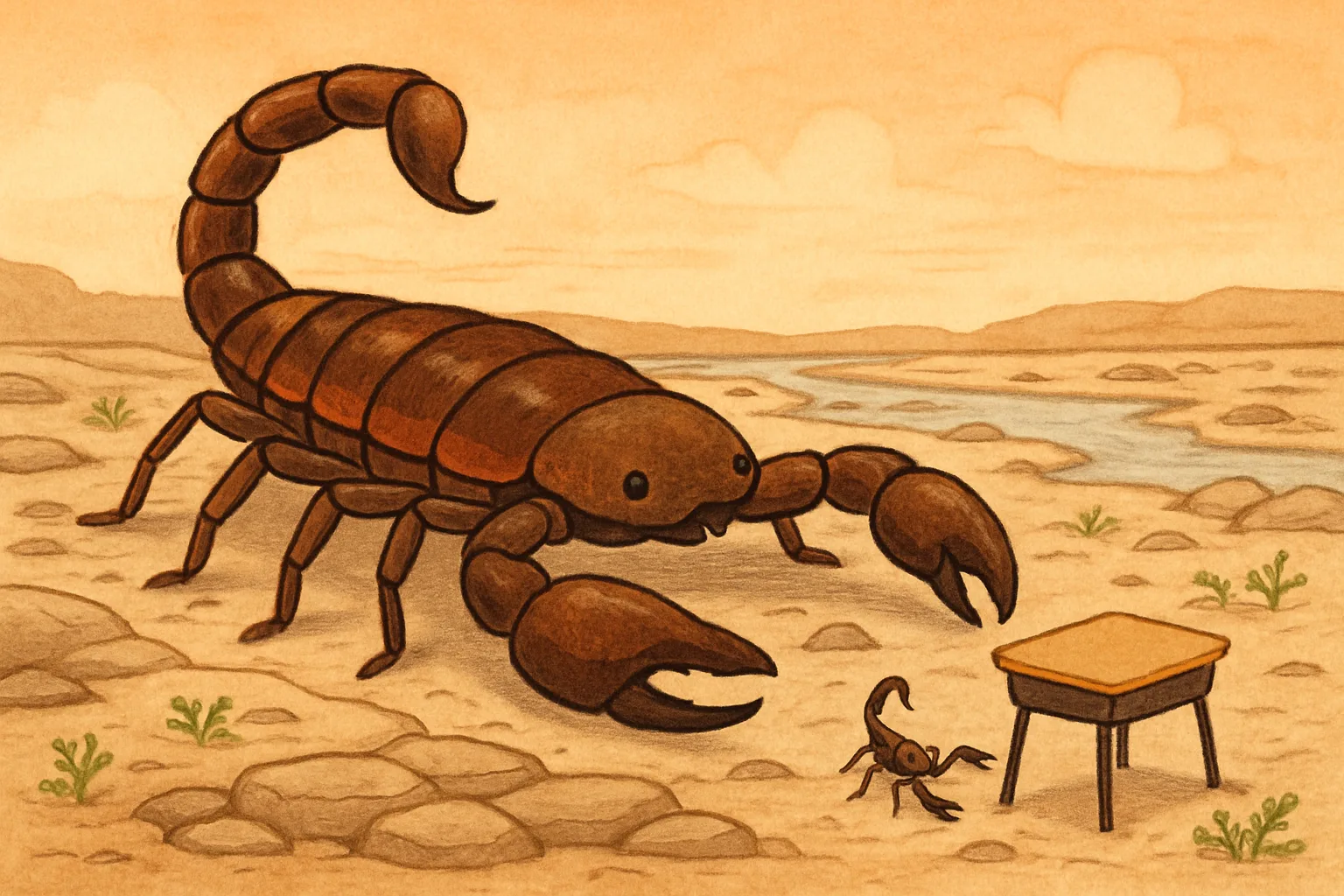
Scientists have confirmed that the largest scorpion ever to live on Earth once prowled the land that is now England and Wales. Called Praearcturus gigas, this ancient creature was about one meter long — roughly the length of a school desk — and had pincers the size of a large ruler. It lived 415 million years ago, when the world looked almost nothing like it does today.
What Happened?
For more than 150 years, the fossils of this creature sat in museum collections, puzzling scientists. Nobody could agree on what kind of animal it actually was. Some thought it might be a crustacean, like a lobster. Now, researchers from the University of Manchester and the Natural History Museum in London have solved the mystery using modern imaging technology.
By scanning the fossils in fine detail and comparing them with other prehistoric creatures, the team confirmed: this was a scorpion. Not just any scorpion — the largest one ever identified. They named it Praearcturus gigas, and their findings were published this week in the journal Palaeontology.
Praearcturus gigas was roughly one meter (about 3.3 feet) long and carried pincers more than 16 centimeters long — that’s about the size of a large ruler sticking out from each side of its head. Today’s scorpions are usually just a few inches long, so this ancient giant would make a modern scorpion look like a tiny ant.
The creature lived 415 million years ago, during a time called the Early Devonian period. Back then, there were no forests. No dinosaurs. No birds. Life on land was still very new. Small plants just a few centimeters tall had only recently started growing on the ground. Most land animals were tiny. That makes Praearcturus gigas’s enormous size an even bigger puzzle.
“What makes Praearcturus so interesting is that it became enormous at a time when life on land was otherwise very small,” said researcher Russell Garwood. Scientists think it may have hunted small arthropods — ancient relatives of insects and spiders — that were pioneering life on land at the same time. The creature may also have been semi-aquatic, spending time both on land and in water.
Why Does It Matter?
This discovery pushes the story of giant scorpions much deeper into Earth’s past. It also changes what scientists thought they knew about how and when large animals first appeared on land. Most scientists believed that truly giant land creatures came much later. Praearcturus gigas shows that nature was already experimenting with enormous sizes hundreds of millions of years earlier than we realized.
Discovers like this remind us that Earth’s ancient history is full of surprises still waiting inside old fossil collections.
Big Words
- Fossil — the preserved remains or traces of an ancient living thing, usually found in rock.
- Palaeontology — the scientific study of ancient life through fossils.
- Devonian period — a time in Earth’s history from about 419 to 359 million years ago, when the first forests were just starting to develop.
- Arthropod — a group of animals with a hard outer shell and jointed legs; it includes insects, spiders, crabs, and scorpions.
- Semi-aquatic — an animal that lives both on land and in water, like a frog or an otter.
Fun Fact
The fossils of Praearcturus gigas had been sitting in the Natural History Museum in London for over a century before anyone realized they belonged to a scorpion. Sometimes the biggest discoveries are hidden right in front of us!
Think About It
If giant scorpions existed 415 million years ago when most land life was tiny, what clues might scientists look for to figure out what this massive creature actually ate?
Sources
- Natural History Museum (London) — World’s largest scorpion revealed by 415-million-year-old fossils
- ScienceDaily — A coffee-table-size scorpion roamed Earth before forests existed
- Phys.org — World’s largest scorpion revealed by 415-million-year-old fossils
- CNN — The largest-ever scorpion roamed Britain 400 million years ago
- Live Science — World’s largest scorpion had 6-inch pincers, and prowled UK land and waters 415 million years ago