
Pizza, Power, and Science! SpaceX Delivers a Giant Package to the Space Station
Quick Summary
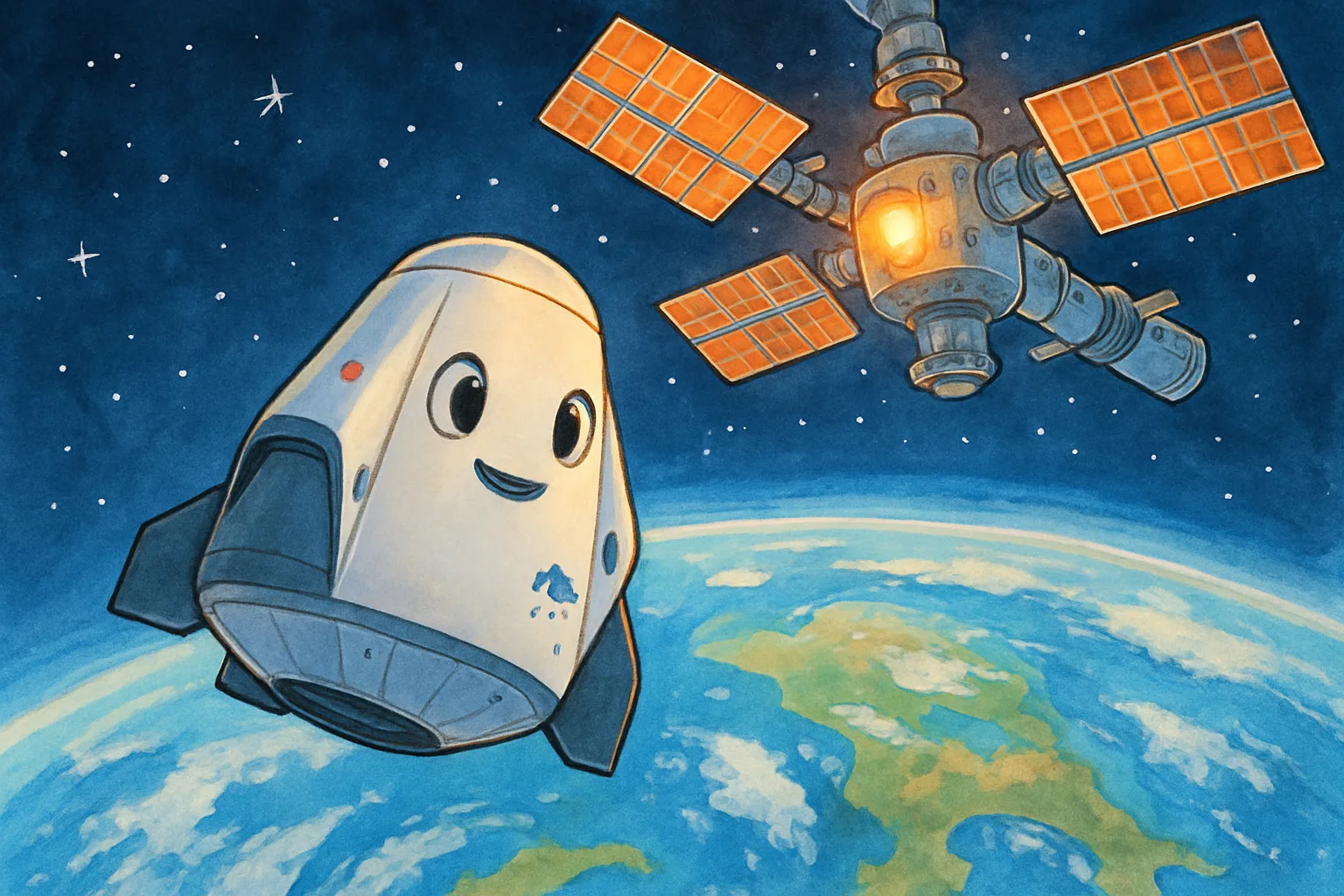
A SpaceX Dragon spacecraft docked at the International Space Station today. It carried more than 6,300 pounds of supplies, science experiments, and special new solar panels. Think of it like the world’s most extreme delivery truck — traveling 250 miles above Earth!
What Happened?
Two days ago, a Falcon 9 rocket blasted off from Cape Canaveral, Florida. It carried a robotic capsule called Dragon into orbit. Dragon spent about 51 hours chasing the space station through the sky. Today, Thursday, October 15, it locked on to the station’s docking port all by itself — no human hands needed.
Inside the capsule was a mountain of cargo. There was fresh food and supplies for the astronauts living on board. There were also science experiments packed inside — including materials to help grow artificial human eye tissue in space. Scientists hope tiny parts called retinas, grown in zero gravity, could one day help people who have lost their sight see again.
The most important items were tucked in Dragon’s unpressurized trunk — the part that stays open to space. These were the very last two roll-out solar arrays, also called iROSAs. Each array unfurls like a giant window blind. Once they are installed on the station, the entire power upgrade project will finally be complete. Those new panels will generate extra electricity — enough to power hundreds more experiments aboard the station.
Astronauts Anil Menon and Joshua Kutryk watched Dragon’s arrival on their screens and were ready to step in if anything went wrong. Everything went smoothly.
Why Does It Matter?
The International Space Station is a flying science lab shared by astronauts from around the world. It needs a steady supply of food, water, tools, and power to keep running. Each Dragon delivery keeps that lab alive and working.
The new solar arrays are a big deal. The station’s original power panels are more than 20 years old. The iROSA upgrade gives the station a fresh boost of energy — like replacing old batteries with brand-new ones. More power means scientists can run more experiments at the same time.
The science cargo is exciting too. Researchers on the ground are hoping that the station’s microgravity — the floating, weightless environment — will let certain materials grow in ways that are impossible on Earth.
Big Words
- Docking — when two spacecraft connect to each other in space, like snapping two toy pieces together
- Microgravity — the nearly weightless condition inside a spacecraft, where everything floats because the ship is in constant free fall around Earth
- Solar array — a panel covered in solar cells that turns sunlight into electricity; the ISS uses these like a giant set of wings
- Retina — the thin layer at the back of your eye that senses light and sends signals to your brain so you can see
- Orbit — the curved path an object takes as it travels around Earth, kept in place by gravity and its own speed
Fun Fact
The International Space Station travels at about 17,500 miles per hour. That means it circles the entire Earth every 90 minutes — the same time as a movie!
Think About It
If you could send one thing to the astronauts on the space station, what would it be and why?
Sources
- Space.com — SpaceX successfully launches 6,300 pounds of cargo to the International Space Station
- NASASpaceFlight.com — CRS-35 set to launch to ISS with final iROSA arrays, experiments, and other items
- Crimson FIT — SpaceX launches CRS-35 resupply mission to the ISS
- NewsBytesApp — SpaceX Cargo Dragon is carrying over 2722kg to ISS