
Ears in the Deep! Sharks Can Hear You From Nearly the Length of a Football Field Away
Quick Summary
Scientists have discovered something amazing about sharks: they can hear sounds from nearly 250 feet away and pinpoint exactly where those sounds are coming from. That is about the length of one football field! It is the first time scientists have measured this in wild, free-swimming sharks.
What Happened?
Shark movies love to show the moment a shark spots something from far away. But scientists at Florida Atlantic University (FAU) wanted to know about a sense that gets much less attention — shark hearing.
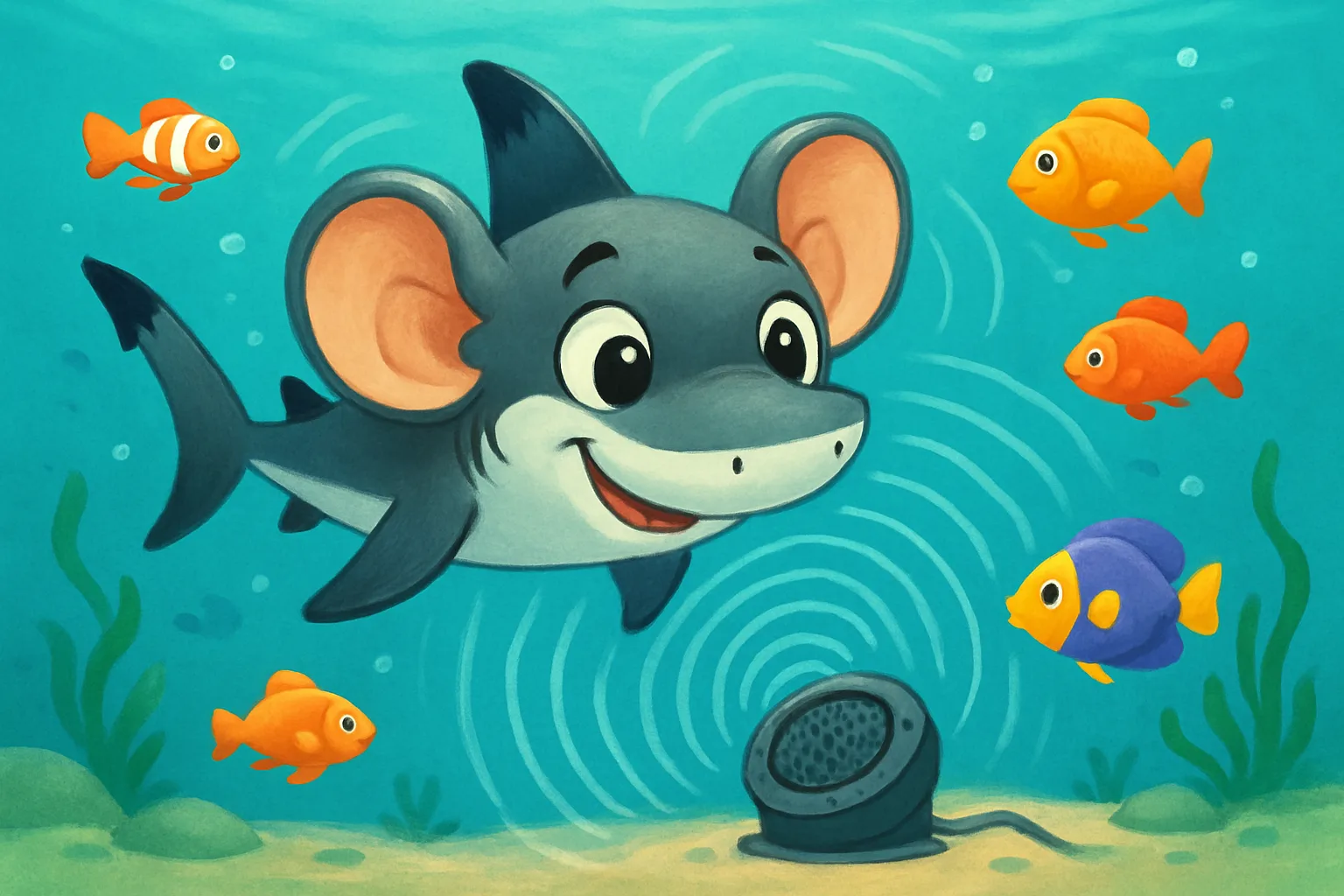
The researchers set up an underwater speaker off the coast of Southeast Florida, in the clear shallow waters of Palm Beach County. Then they watched wild blacktip sharks from a drone flying overhead. When the speaker played low, rumbling sounds, the sharks — some almost 250 feet away — quickly changed direction and swam away from the noise.
More than 70 out of every 100 of those responses happened when the sharks were in what scientists call the “acoustic far field” — which simply means far enough away that the sound had already spread out in all directions, like ripples from a pebble dropped in a pond. Not only did the sharks hear the sound from that distance, they also knew which direction it was coming from.
The study found that sharks are especially good at hearing low-frequency sounds — the deep, rumbling kind. Think of the difference between a tuba and a flute. Sharks are much better at hearing the tuba.
Why Does It Matter?
Sharks are ancient hunters. Their basic body design has barely changed in hundreds of millions of years. Scientists think their sharp hearing helps them find prey, avoid danger, and navigate the ocean — all before they ever use their eyes or sense of smell.
Knowing how far sharks can hear also helps researchers design better ways to protect both sharks and swimmers. For example, if certain sounds make sharks swim away, that knowledge could one day be used to guide sharks away from swimming beaches or fishing nets — keeping both sharks and people safer.
As the researchers put it, the ocean is an acoustic world, and sharks are deeply tuned into it.
Big Words
- Acoustic — Relating to sound or hearing.
- Far field — The zone far enough from a sound source that the sound waves have spread evenly in all directions, like ripples far from where a stone hit the water.
- Low frequency — A slow, deep sound wave — like the rumble of a bass drum, compared to the high squeak of a whistle.
- Echolocation — Using sound and its echoes to “see” surroundings (bats and dolphins do this; sharks use sound differently — they detect it rather than produce it for navigation).
- Predator — An animal that hunts and eats other animals.
Fun Fact
Blacktip sharks migrate along Florida’s coastline every winter in huge groups — sometimes thousands of sharks swimming together. That is what gave scientists the perfect chance to study their hearing in the wild!
Think About It
Sharks can hear sounds that humans make in the water from very far away. If you were designing an underwater park for swimming, how might you use this new information to help keep both swimmers and sharks safe?
Sources
- Florida Atlantic University / Newswise — Sharks Can Hear Sounds Nearly 250 Feet Away and Find the Source
- phys.org — Sharks can hear sounds nearly 250 feet away and find the source
- ScienceDaily — Sharks Can Hear Nearly 250 Feet Away and Pinpoint the Source