
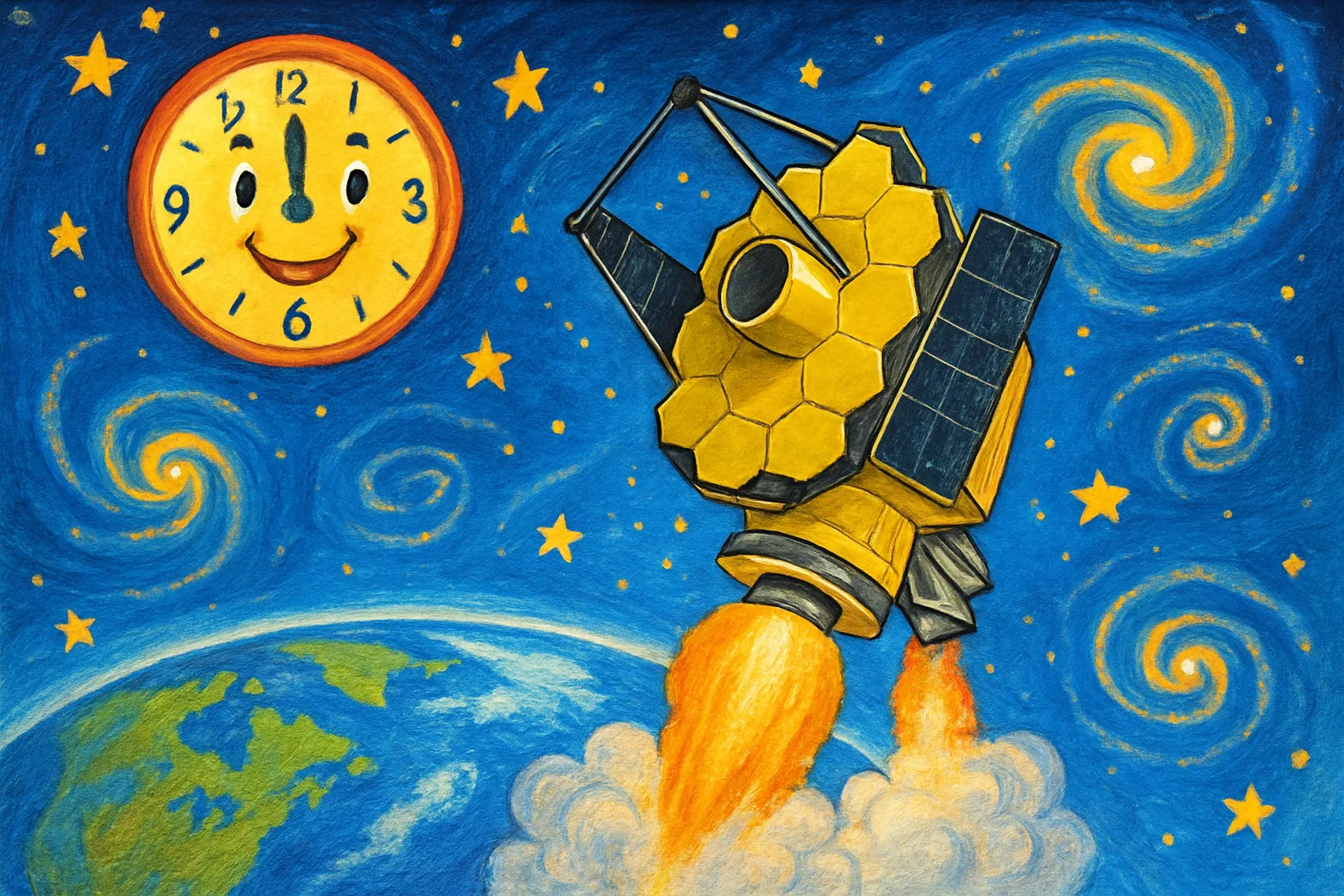
T-Minus 12 Days! NASA’s Biggest New Telescope Ever Is Almost Ready to Fly
Quick Summary
In just 12 days, NASA will launch one of the most powerful space telescopes ever built. It is called the Nancy Grace Roman Space Telescope, and it will be able to photograph a patch of sky 100 times wider than the famous Hubble Space Telescope — all in a single snapshot. Get ready for some extraordinary pictures of our universe!
What Happened?
NASA has confirmed that the Nancy Grace Roman Space Telescope is set to launch on Sunday, August 30, 2026, at 7:26 in the morning from the Kennedy Space Center in Florida. A SpaceX Falcon Heavy rocket — one of the most powerful rockets flying today — will carry it into space.
The Roman telescope is finished, fully tested, and fueled up. Engineers have spent years carefully building and checking every part. NASA says the telescope is actually launching about nine months earlier than originally planned. That is like finishing a huge school project way ahead of the deadline!
So what makes this telescope special? Roman has a main mirror that is 7.9 feet across — exactly the same size as the famous Hubble Space Telescope’s mirror. But behind that mirror sits an extraordinary camera. In a single exposure, Roman photographs a patch of sky that would take Hubble 100 separate photographs to cover.
Imagine Hubble is looking at the universe through a drinking straw. Roman is looking through a dinner plate.
Roman will orbit Earth about 930,000 miles away — almost four times the distance from Earth to the Moon. It will sit at a special gravitational sweet spot in space where it can always look out at the universe without Earth or the Sun getting in the way.
The telescope is named after Nancy Grace Roman, who was NASA’s very first Chief of Astronomy. She played a huge role in making the Hubble Space Telescope a reality. Because of that, she is often called the “Mother of Hubble.”
Why Does It Matter?
Roman will take on some of the biggest mysteries in all of science. One of its main goals is to study dark energy — a mysterious force that is making the entire universe expand faster and faster. Scientists do not know what dark energy is, but it makes up most of the universe’s energy! Roman will map roughly one billion galaxies to help scientists figure it out.
Roman will also hunt for planets orbiting other stars. It has a special tool called a coronagraph that can block out a star’s bright light, letting scientists look for dimmer planets hiding right next to it — like trying to spot a firefly sitting next to a searchlight.
Scientists call Roman the biggest space astronomy mission since the James Webb Space Telescope launched in 2021. Webb looks deep and narrow; Roman looks wide. The two telescopes will work together as an incredible team, each doing what the other cannot.
Big Words
- Telescope — a tool for gathering light from far away objects so we can study them; space telescopes orbit above Earth’s atmosphere to get even clearer views
- Dark energy — a mysterious invisible force that is causing the universe to expand faster and faster; scientists still do not fully understand what it is
- Coronagraph — a device inside a telescope that blocks a star’s bright light so fainter objects near it, like planets, can be seen
- Orbit — the curved path that one object in space follows around another, like how Earth circles the Sun or how a satellite circles Earth
- Infrared light — a type of light our eyes cannot see, but telescopes can detect it; it helps scientists see through dust clouds in space
Fun Fact
The Roman Space Telescope’s camera has about 300 megapixels — that is like taking 300 million tiny pixel-dots and stitching them into one giant picture. Most phone cameras have 12 to 50 megapixels. Roman’s camera is roughly six to 25 times bigger than a modern smartphone camera!
Think About It
If you could point the Roman Space Telescope at anything in the universe, what would you choose — and what mystery would you hope it would solve?
Sources
- NASA Science — Nancy Grace Roman Space Telescope launch page (nasa.gov)
- Britannica — Nancy Grace Roman Space Telescope entry
- SpacePolicyOnline — NASA Sets Launch Date for Roman Space Telescope
- TechTimes — NASA Moves Roman Space Telescope Launch Up To August 30
- SpaceDaily — NASA’s Nancy Grace Roman Space Telescope launching on a Falcon Heavy on 30 August 2026