
Meet the Newest Tree on Earth! Scientists Find a Brand-New Baobab
Quick Summary
Scientists have officially identified a brand-new species of baobab tree in Madagascar. Using DNA tests, researchers proved that what everyone thought was one species of baobab is actually two separate species. This brings the total number of known baobab species in the world to nine.
What Happened?
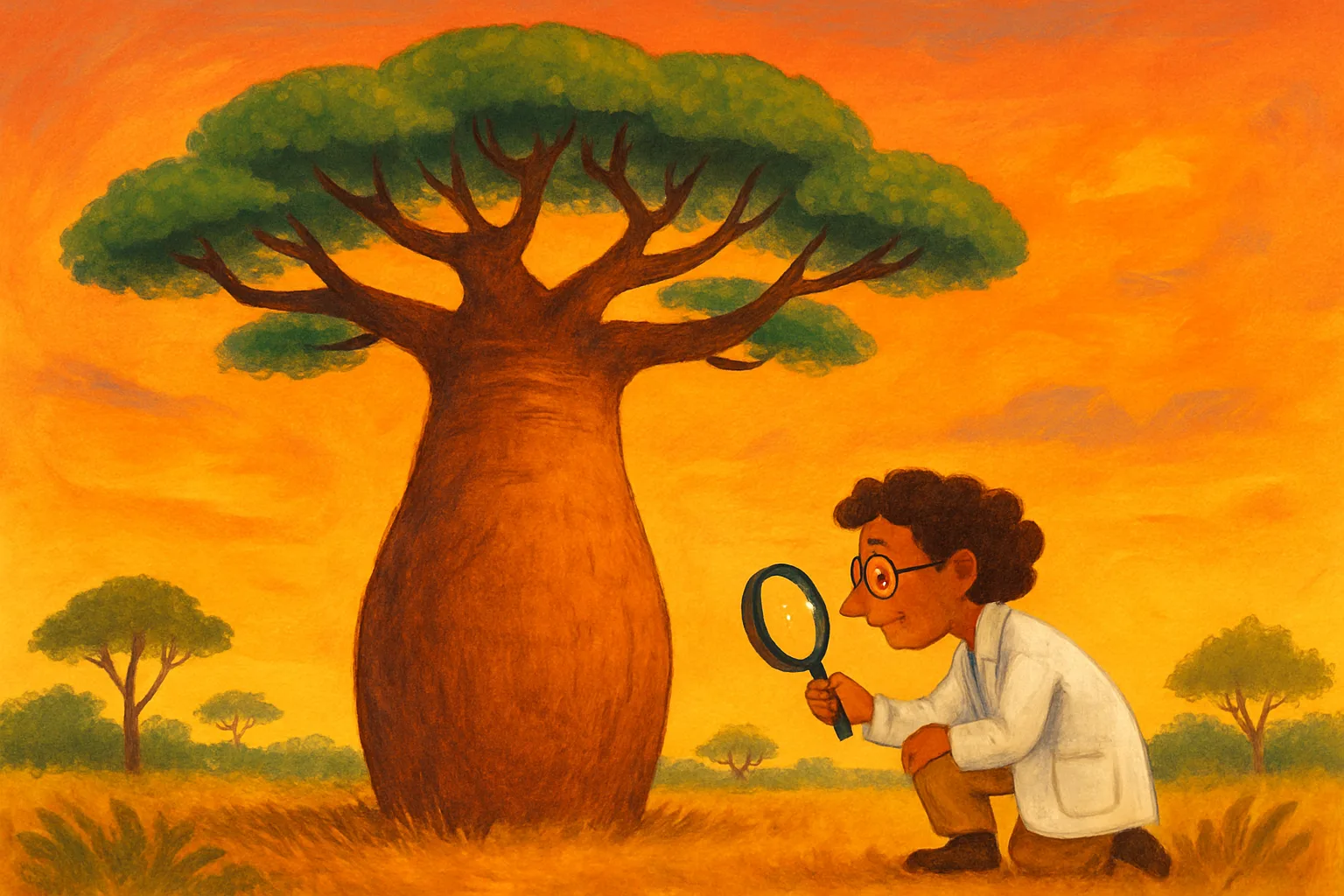
Baobab trees are some of the most famous trees on Earth. They have enormous, swollen trunks that can store thousands of liters of water — like a giant, living water tower. Their thick horizontal branches look so much like roots that many people call baobabs “upside-down trees.” Some baobabs live for thousands of years.
Most of the world’s baobab species grow on the island of Madagascar, a large island off the southeastern coast of Africa. Scientists at the University of Wisconsin–Madison and the Missouri Botanical Garden were studying Madagascar’s baobabs when they made a surprising discovery.
One well-known baobab species, called Adansonia za, is found across Madagascar. For a long time, everyone assumed all the trees in this species were the same. But when the scientists ran careful DNA tests on trees from different parts of the island, they found something unexpected. The baobabs in the north of Madagascar were genetically much more similar to other northern species than to the trees in the south that they supposedly shared a species with.
In other words, the trees in the north were actually a different species all along. The new species has been named Adansonia bozy. Scientists had even given this name to the tree over 100 years ago — it had just never been formally confirmed. Now it is official.
The findings were published in the scientific journal Taxon.
Why Does It Matter?
Knowing that Adansonia bozy is its own species is not just exciting for science — it is important for saving the tree. The forests where Adansonia bozy grows, in northwestern Madagascar, are being cut down for farming. Scientists say the species is likely endangered because its population is small and its habitat is shrinking.
Now that scientists know it is a separate species, they can create special conservation plans just for it — like protecting the specific forests where it lives and tracking how many trees remain.
The discovery also shows that even in famous, well-studied groups of plants, surprises are still waiting to be found. DNA technology is making it possible to see differences that the human eye simply cannot.
Big Words
- Species — a group of living things so similar to each other that they can reproduce together; different species cannot breed with each other
- DNA — the chemical code inside every living cell that acts like a blueprint, carrying information about what an organism looks and acts like
- Baobab — a type of large, long-lived tree famous for its swollen trunk and unusual look, found in Africa, Madagascar, and Australia
- Endangered — describes a species with so few members alive that it is at serious risk of disappearing from Earth forever
- Taxonomy — the science of finding, naming, and classifying living things into groups based on how they are related
Fun Fact
Baobab trees can store up to 120,000 liters of water in their trunks — that is enough to fill about 50 bathtubs! This helps them survive long, dry seasons.
Think About It
Scientists used DNA — invisible to the naked eye — to discover a “hidden” species hiding in plain sight. What other living things do you think might be secretly two different species that look the same?
Sources
- phys.org — Genetic analysis reveals new species of endangered baobab tree in Madagascar (Aug 14, 2026)
- Newswise / University of Wisconsin–Madison — Researchers Differentiate New Species of Endangered Baobab Tree in Madagascar (Aug 14, 2026)
- Sci.News — New Baobab Species Identified in Madagascar (Aug 17, 2026)
- Taxon journal — Phylogenomic analysis of Madagascar’s baobabs reveals admixed populations and supports resurrection of a previously described species (2026)