
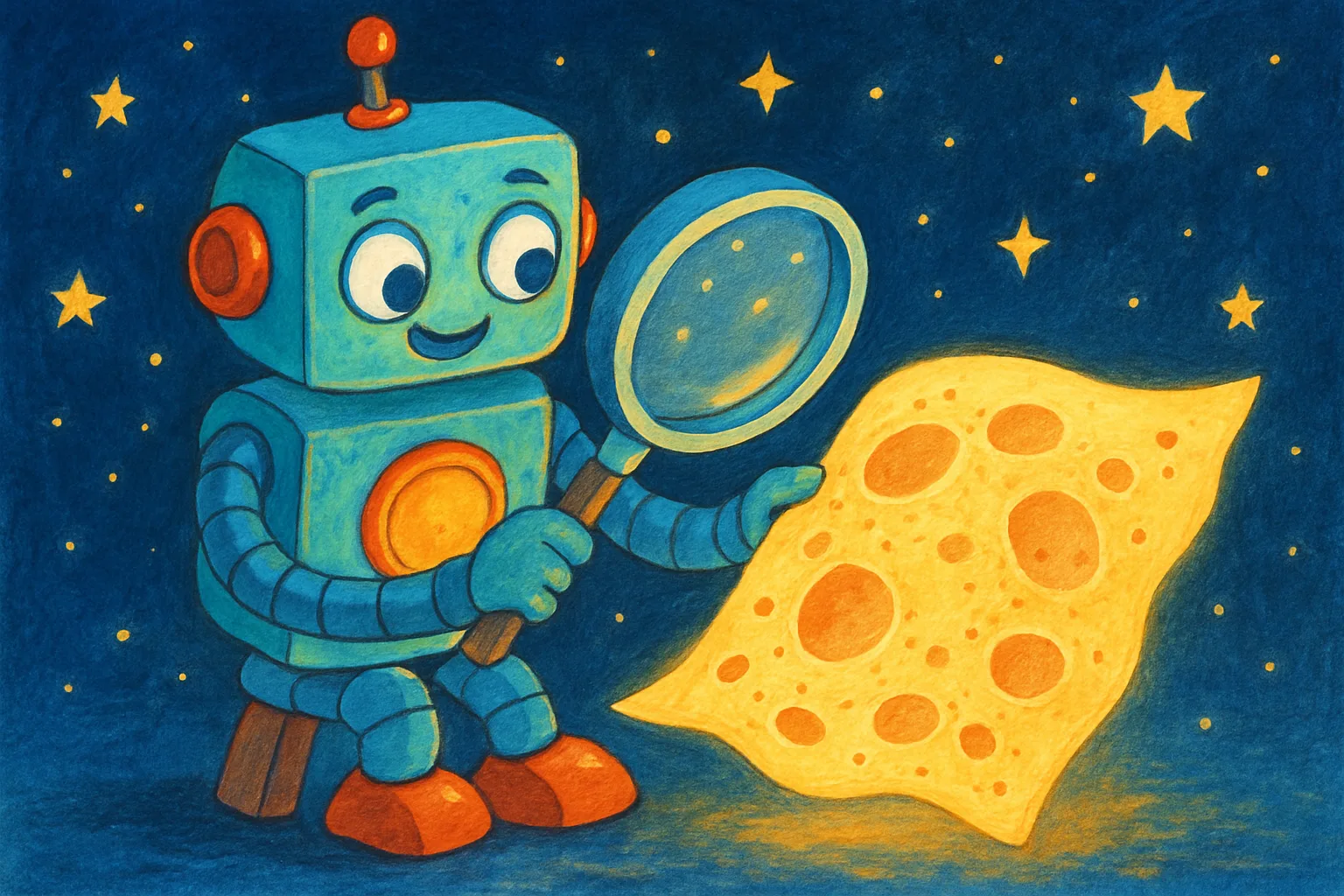
Moon Detective! NASA and IBM Built an AI That Reads the Moon Like a Book
Quick Summary
NASA and IBM have teamed up to release a free AI tool that helps scientists study the Moon. The tool — called the NASA-IBM Lunar Foundation Model — can find ice, spot craters, and map the Moon’s rocky surface. It could help plan future missions to send astronauts to the Moon.
What Happened?
For decades, spacecraft have been flying around the Moon and sending back mountains of data. One spacecraft alone — NASA’s Lunar Reconnaissance Orbiter — has collected more information than all of NASA’s other planetary missions put together. That is like if your school library had millions of books, but no index to help you find anything.
NASA and IBM built this new AI tool to be the Moon’s librarian. The model was trained on data from nine instruments across four NASA missions. It learned from more than 30 different layers of information about the Moon’s surface.
The tool is especially good at spotting water ice. The Moon’s south pole has dark craters that sunlight never reaches — colder than anywhere on Earth. Scientists believe ice is hiding in those shadows. The new AI can predict where that ice might be with 22% less error than the best tool scientists had before.
The model has been made free for anyone to use and download. Researchers around the world can access it through a website called Hugging Face. Scientists hope the tool will speed up discoveries and help NASA plan safe landing spots for astronaut missions.
Why Does It Matter?
NASA’s Artemis program wants to land astronauts near the Moon’s south pole. If ice really is there, it could be used as drinking water. It could also be split into hydrogen and oxygen to make rocket fuel for trips to Mars. Finding that ice is a top priority.
This AI tool is like giving scientists a superpower. Instead of spending years carefully going through old data by hand, the AI can scan millions of records in seconds. That means less time searching and more time discovering.
Big Words
- Artificial intelligence (AI) — computer programs that learn from huge amounts of information and use that knowledge to solve problems, a bit like teaching a computer to think
- Foundation model — a large AI system trained on lots of data that can then be adapted to do many different tasks
- Lunar — anything related to the Moon (from the Latin word for Moon)
- Ice deposit — a place where ice is buried or hidden, often underground or in deep shadow
- Open-source — software that anyone can use, study, and share for free
Fun Fact
The permanently shadowed craters at the Moon’s south pole can be colder than minus 200 degrees Celsius (minus 328 degrees Fahrenheit). That is colder than the surface of Pluto!
Think About It
If you could send a robot to explore one place on the Moon, where would you send it and what would you hope it finds?
Sources
- NASA Science — NASA, IBM Launch AI Foundation Model for Lunar Science (nasa.gov, Sept. 10, 2026)
- Space.com — NASA, IBM launch new AI model for studying the moon (Sept. 12, 2026)
- IBM Newsroom — IBM and NASA Release Open-Source AI Model to Support Lunar Exploration (Sept. 10, 2026)
- TechNode Global — IBM and NASA launch open-source lunar AI model (Sept. 12, 2026)