
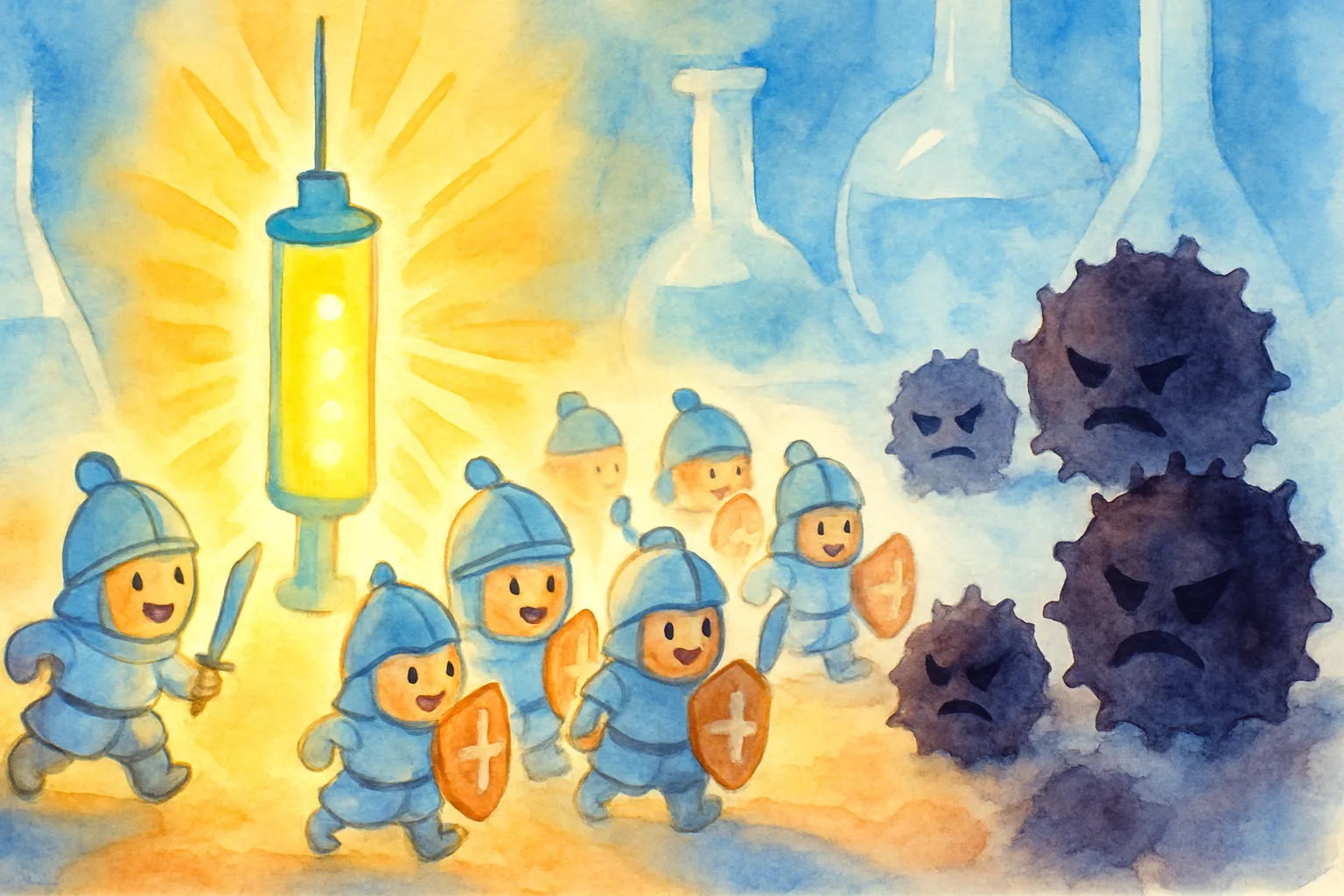
Your Body’s Own Army! A Custom Cancer Vaccine Just Passed Its Biggest Test
Quick Summary
Scientists announced this week that a brand-new kind of cancer vaccine passed its biggest medical test yet. The vaccine is custom-made for each patient — like a suit of armor built just for you. It helped stop a dangerous type of skin cancer from coming back after surgery.
What Happened?
Most vaccines protect you from getting sick. This new vaccine works differently. It is used after doctors have already removed a patient’s cancer tumor through surgery. The vaccine then helps the patient’s own immune system hunt down any remaining cancer cells that might be hiding in the body.
Here is what makes it truly amazing: every single dose is made just for one person. Doctors take a tiny sample of the removed tumor and read its unique genetic code — like reading a secret message. They find up to 34 special markers, called neoantigens, that appear only on that patient’s cancer cells. These markers are like flags on the cancer cells that say “I do not belong here.”
The vaccine teaches the immune system to spot those flags. Think of it like giving your body’s defense team a wanted poster for the specific criminal they need to catch. The immune system then knows exactly what cancer cells look like and attacks them.
This vaccine — called intismeran — was developed together by two pharmaceutical companies, Moderna and Merck. Moderna is the same company that helped create one of the first COVID-19 vaccines.
In the new study, more than 1,100 patients with a dangerous type of skin cancer called melanoma joined the trial. Half received the personalized vaccine plus an existing treatment. The other half received just the existing treatment. The group who got the vaccine lived longer without their cancer returning. The cancer also spread less often.
This is the first time a personalized mRNA cancer vaccine has succeeded in a large, late-stage medical trial. Moderna and Merck plan to ask regulators for official approval within months.
Why Does It Matter?
Melanoma is one of the most serious skin cancers. About 112,000 new cases are diagnosed in the United States each year. For patients with the most advanced forms, only about one in three survive five years after diagnosis. A vaccine that reduces the chance of cancer returning is a huge step forward.
Scientists are also excited because the same approach could work for many other types of cancer. Moderna and Merck are already testing similar personalized vaccines for lung, bladder, and kidney cancers. One day, a vaccine made just for your cancer could become a regular part of treatment.
Big Words
- Melanoma — the most dangerous form of skin cancer, which can spread to other parts of the body if not treated quickly
- mRNA — a tiny set of genetic instructions that cells can read, like a recipe card that tells the body what proteins to make; mRNA vaccines use this to train the immune system
- Neoantigen — a special marker found only on cancer cells that tells the immune system “this cell does not belong here”
- Immune system — the body’s built-in defense team — made of billions of cells — that fights off germs, viruses, and other threats
- Clinical trial — a carefully organized medical study involving real patients, used to test whether a new treatment is safe and effective
Fun Fact
Each personalized cancer vaccine is created from scratch based on one patient’s own tumor — meaning no two doses in the entire world are exactly alike!
Think About It
Scientists can now read the genetic code of a single person’s cancer cells and build a medicine just for them. What other diseases do you think scientists might one day be able to fight in a personalized way?
Sources
- STAT News — Moderna and Merck say mRNA cancer vaccine succeeded in late-stage melanoma trial
- CNN — Moderna and Merck say melanoma vaccine succeeded in large trial
- CNBC — Cancer vaccine from Moderna, Merck shows promise in late-stage trial
- Nature — Moderna cancer vaccine stops melanoma returning: what’s next for personalized treatments?
- Boston Globe — Cancer vaccine using mRNA succeeded in late-stage melanoma trial