
The Canyon’s Missing Pages! Scientists Solve a Billion-Year Mystery
Quick Summary
The Grand Canyon is like a giant book of Earth’s history written in rock layers. But scientists have noticed something strange — more than a billion years of pages are missing! A new study may finally explain why.
What Happened?
Imagine reading a history book and suddenly noticing that hundreds of chapters have been ripped out. That is exactly the puzzle scientists found in the Grand Canyon. The canyon holds rock layers stretching back two billion years. But a huge chunk of time — over a billion years — has no rock record at all. Scientists call this gap the “Great Unconformity.”
Now, a team led by researchers at the University of Southampton in the United Kingdom thinks they have found the answer. Their study was published this week in the scientific journal Geology.
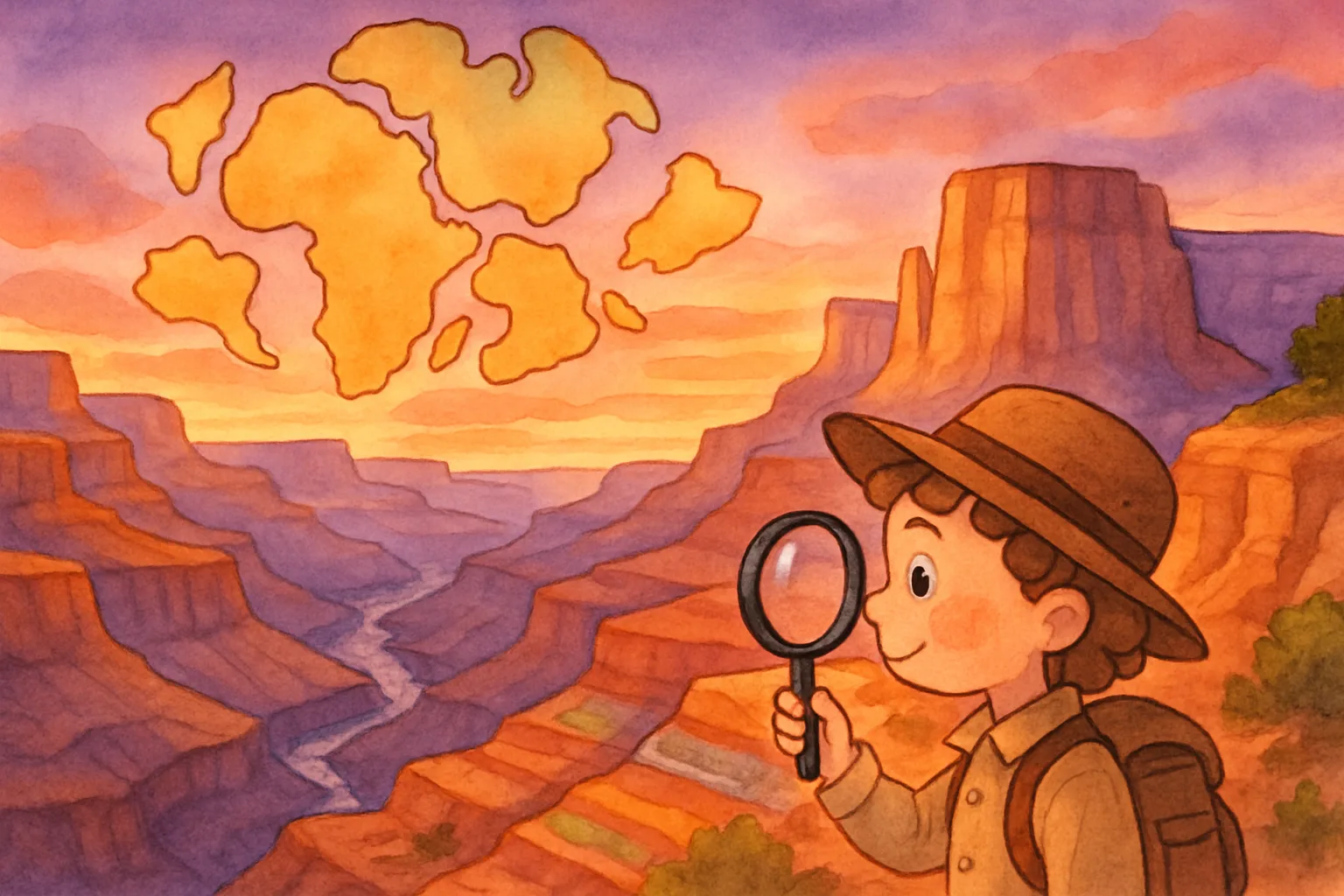
The key is an ancient supercontinent called Rodinia. About 800 million years ago, Rodinia began cracking apart — think of a giant chocolate bar snapping into pieces. As it broke apart, a colossal cliff system formed along the edge of what would become North America.
This cliff — called the Great Escarpment of Laurentia — was about one kilometer tall. That is roughly three times the height of the Empire State Building! It stretched for thousands of kilometers across what are now states like Arizona, Utah, Wyoming, Colorado, and Illinois.
Over millions and millions of years, rain, wind, and ice slowly wore down this giant cliff. As it crumbled, it scraped away enormous amounts of rock — possibly as much as five miles deep in some places. That wiped out the ancient rock layers completely, leaving behind the mysterious billion-year gap we see in the Grand Canyon today.
Researchers used computer models of ancient plate tectonics and landscape changes to piece this story together.
Why Does It Matter?
The Grand Canyon has puzzled scientists since explorer John Wesley Powell first described the missing rock gap in 1869. That is more than 150 years of wondering! This new idea gives geologists a powerful clue about how Earth’s surface has dramatically changed over billions of years.
It also shows how breaking apart a supercontinent can reshape a planet. The same type of giant cliff-and-erosion system exists today in South Africa and Brazil. Scientists used those as clues to understand what happened here in North America long ago.
Big Words
- Great Unconformity — the mysterious billion-year gap in the Grand Canyon’s rock layers where rocks that should exist are completely missing
- Supercontinent — a massive landmass made up of many continents joined together; Rodinia was one such supercontinent 800 million years ago
- Escarpment — a long, steep cliff or rocky slope, often caused by erosion or shifts in Earth’s plates
- Erosion — the slow wearing away of rock and soil by water, wind, ice, or gravity over time
- Plate tectonics — the science of how Earth’s giant rocky plates slowly move, collide, and break apart, reshaping the planet’s surface
Fun Fact
The ancient cliff that helped erase a billion years of rock was about three times taller than the Empire State Building — and it stretched so far it would have crossed at least ten modern U.S. states!
Think About It
If you could dig down to the very bottom of the Grand Canyon, you would be touching rocks that are nearly two billion years old. What do you think Earth looked like back then — before there were any dinosaurs, plants, or animals?
Sources
- EurekAlert — Lost ‘mega-escarpment’ across ancient USA may explain Grand Canyon’s missing billion years
- Phys.org — Lost ‘mega-escarpment’ across ancient USA may explain Grand Canyon’s missing billion years
- Courthouse News Service — A discovery may explain the Grand Canyon’s missing billion years
- Space.com — Mystery of Grand Canyon’s lost rocks may finally be solved
- The Debrief — The Death of a Supercontinent May Have Formed the Grand Canyon Close to a Billion Years Earlier than Once Thought