
Europe Breaks Temperature Records — and Scientists Are Racing to Help
Quick Summary
Over the past few weeks, Europe has been hit by an extraordinary heatwave. Temperatures smashed records in at least 13 countries. Scientists, doctors, and governments are working hard to keep people safe — and are studying how to do better in the future.
What Happened?
Since late May, a series of powerful heatwaves has been roasting Europe. Temperatures climbed to heights more typical of the Sahara Desert than a European summer.
On June 28, Poland shattered its all-time temperature record. A town called Słubice, on Poland’s western border with Germany, hit 40.5°C — that’s about 105°F. To put that in perspective, the previous record was 40.2°C, set all the way back in 1921. Poland had never been that hot in over 100 years of record-keeping! The city of Toruń also reached 40.3°C that same day, also above the old record.
Poland was far from alone. Temperature records were broken in Austria, Belgium, France, Germany, Hungary, Italy, the Netherlands, Romania, Spain, and more. France shattered its own national record too, with some regions climbing above 43°C — hotter than a very hot bath. Scientists at the World Meteorological Organization, or WMO, confirmed that Europe is the world’s fastest-warming continent, heating up at more than twice the global average rate over the past few decades.
What causes a heatwave this strong? This one was powered by a surge of hot, dry air from North Africa that got trapped over Europe. Meteorologists describe the pattern as an “Omega block” — the trapped air sits like the Greek letter Ω on a weather map, with the hot air locked in the middle and cooler air blocked on both sides. Imagine putting a lid on a pot of boiling water and not letting the steam escape.
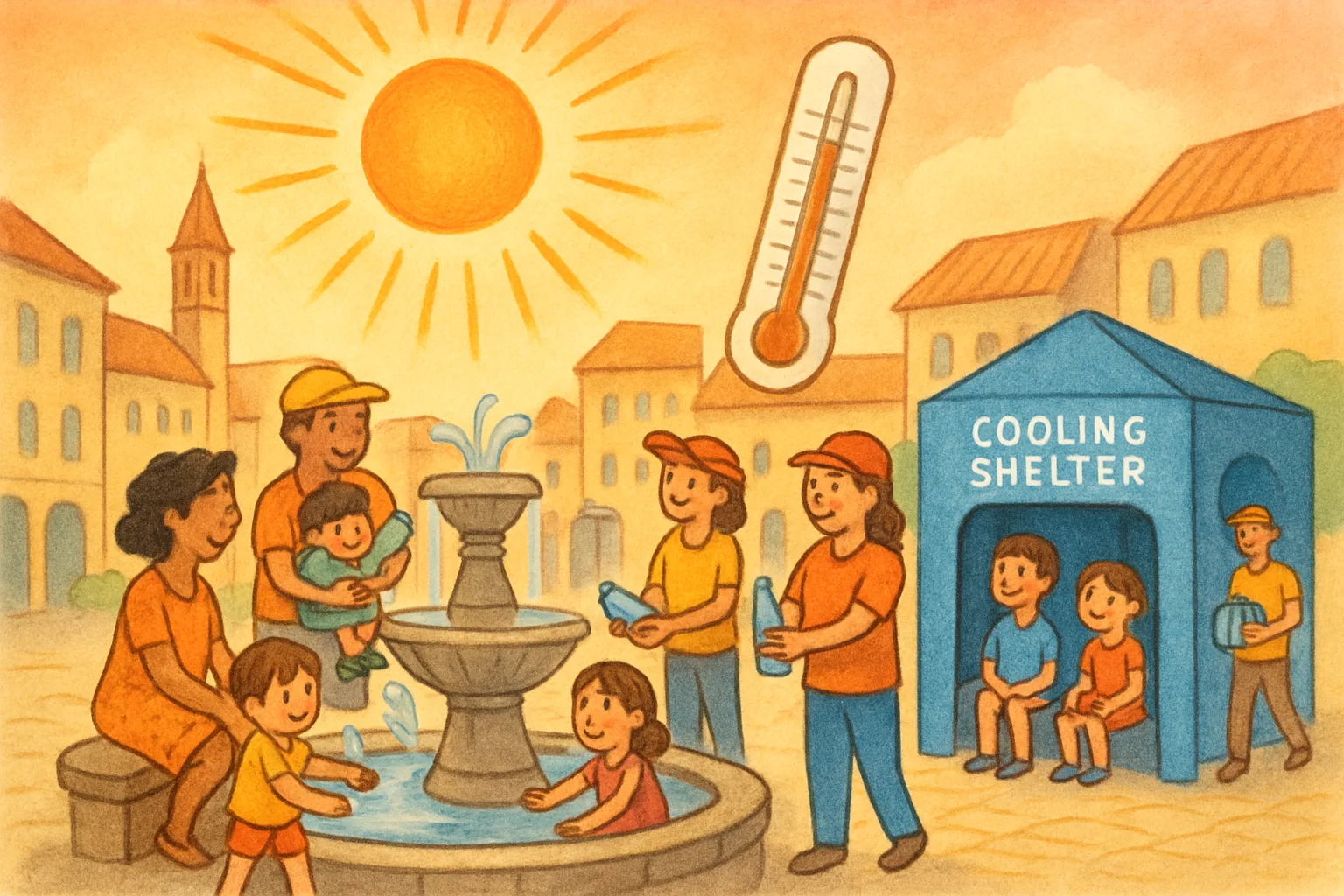
So what are the helpers doing about it? Across Europe, governments opened cooling centers — special buildings people can visit for free to escape the heat. Cities set up water distribution stations and spray parks. Schools in some countries adjusted their schedules or closed early. The WMO and WHO launched coordinated health action plans, sending out early warnings so people could prepare before the hottest days arrived.
The WHO’s European office said on June 30 that this heatwave was like a “dress rehearsal” for the future. They convened an emergency meeting of health officials from across the continent. The message was important and hopeful: preparation works. Scientists estimate that heat-related deaths in Europe in 2023 would have been about 80% higher without the protection systems already in place. Heat action plans, early warning systems, and cooling spaces are genuinely saving lives.
More than half of European countries still do not have full heat-health action plans. The WHO is helping them build those plans right now, so they are better prepared for the summers to come.
Why Does It Matter?
Heatwaves are becoming more frequent and stronger because of climate change. The good news is that humans are also getting better at preparing for them. Early warning systems, cooling shelters, and community check-ins can protect the people who are most at risk — especially the elderly, young children, and outdoor workers. Every country that builds a better heat plan is protecting its people for the future.
Big Words
- Heatwave: A period of unusually hot weather lasting several days or weeks — not just one hot afternoon.
- Temperature record: The highest (or lowest) temperature ever measured in a place. When records are broken, it means the weather is doing something it has never done before in recorded history.
- Omega block: A weather pattern where a bubble of hot air gets trapped over a region because cooler air systems on both sides prevent it from moving away.
- Cooling center: A public building — like a library or community hall — kept cold during a heatwave so anyone can go there for free to cool down.
- Heat-health action plan: A step-by-step guide that a city or country follows during a heatwave to keep people safe, including sending warnings, opening shelters, and checking on vulnerable people.
Fun Fact
Europe has warmed by about 2°C (3.6°F) in just the last 50 years — and it is warming faster than almost any other part of the world. Scientists at WMO keep track of every new record, using data from thousands of weather stations across the continent.
Think About It
If you were designing a “perfect” cooling center for your neighborhood, what would you put inside it to help as many different people as possible?
Sources
- World Meteorological Organization (wmo.int) — ‘Record-breaking heat spreads through Europe’ (Jun–Jul 2026)
- World Health Organization Europe (who.int) — ‘Get prepared: current European Region heatwaves are a dress rehearsal’ (Jun 30, 2026)
- UN News (news.un.org) — ‘Europe heatwave breaks records as UN agencies ramp up health warnings’ (Jun 25, 2026)
- Notes From Poland — ‘Poland records highest ever temperature as European heatwave moves east’ (Jun 28, 2026)
- TVP World — ‘Raging heatwave breaks Poland’s century-old temperature record’ (Jun 28, 2026)
- Wikipedia — ‘2026 European heatwaves’ (updated Jul 5, 2026)