
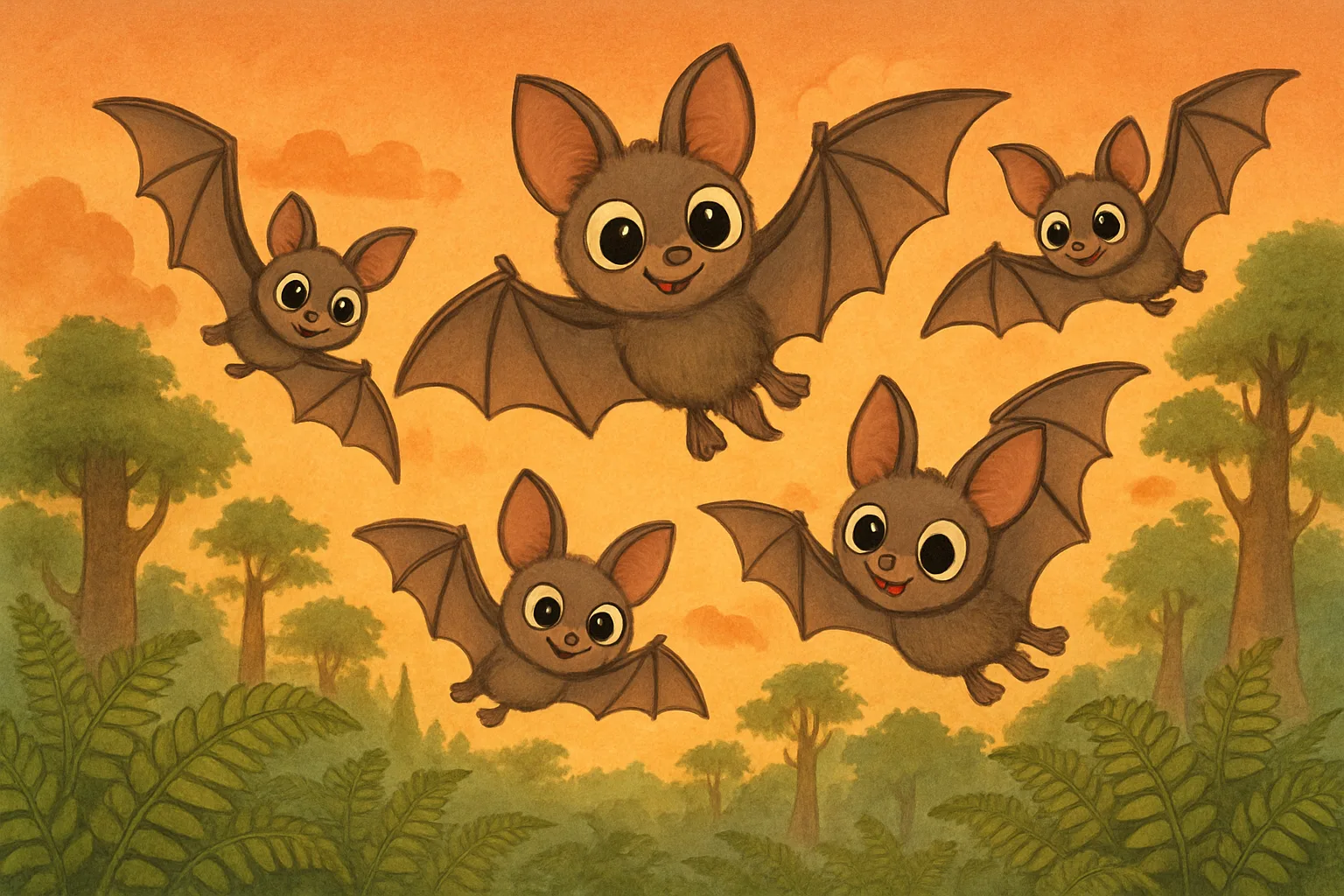
Mystery Solved! The World’s Very First Bats Took Flight in Europe
Quick Summary
Scientists have cracked one of nature’s oldest puzzles: where did bats come from? A massive new study says the very first bats evolved in Europe about 65 million years ago. That is right after the asteroid that wiped out the dinosaurs!
What Happened?
Bats are amazing animals. They are the only mammals on Earth that can truly fly. But for decades, scientists argued about where the very first bat was born. Was it Asia? Africa? North America? Nobody could agree.
Now, an international team of 137 scientists from 64 countries worked together to solve the mystery. They studied the DNA of 103 different bat species — that is almost like reading the instruction manuals for 103 different creatures. They also studied 44 ancient bat fossils. It was the biggest study of bats ever done.
The result? Bats most likely first appeared in Europe, roughly 65 million years ago. That is just one million years after the asteroid that killed the non-bird dinosaurs hit Earth. Back then, with the big dinosaurs gone, small furry mammals had a lot more room to grow and change.
From Europe, the earliest bats spread first to Africa. Then their descendants fanned out to Asia, the Americas, and Australia. Today, bats live on every continent except Antarctica.
The study also solved another mystery: bats developed their two superpowers — true powered flight and echolocation (their built-in sound radar) — very early on, close to the very beginning of bat history.
Why Does It Matter?
Bats make up about one in every five mammal species on Earth. They eat billions of insects every night, helping protect crops. Some bats pollinate flowers, just like bees. Understanding where bats came from helps scientists understand how all of today’s wild animals evolved.
This study is also a reminder that Europe, which today is famous for its cities and history, was once a wild, steamy forest full of brand-new creatures finding their way in a world without giant dinosaurs.
Big Words
- Evolution — The slow process by which living things change over many generations until they become new species.
- Echolocation — A special ability where animals send out sound waves and listen to the echoes to “see” objects in the dark — like a natural sonar system.
- Genome — The complete set of DNA instructions inside a living thing — like a full recipe book for building that creature.
- Fossil — The preserved remains or shapes of ancient living things, found inside rock.
- Palaeocene — A time period on Earth from about 66 to 56 million years ago, right after the dinosaurs went extinct.
Fun Fact
There are more than 1,400 known species of bats today. If you lined them all up by wingspan, the smallest — the bumblebee bat — is only about the size of a jelly bean, while the giant golden-crowned flying fox has a wingspan wider than a kindergartener is tall!
Think About It
Bats appeared on Earth just one million years after the asteroid that killed the dinosaurs. Why do you think big changes — like a mass extinction — might actually help NEW animals evolve and grow?
Sources
- University College Dublin / Bat1K — Bats originated and took first flight in Europe, new UCD-led research suggests
- phys.org — Bat genomes and fossils point to a European origin 65 million years ago
- Washington Post — What a landmark new study reveals about the origin of bats
- Live Science — Earth’s first bats didn’t come from where we thought, landmark genetic study reveals